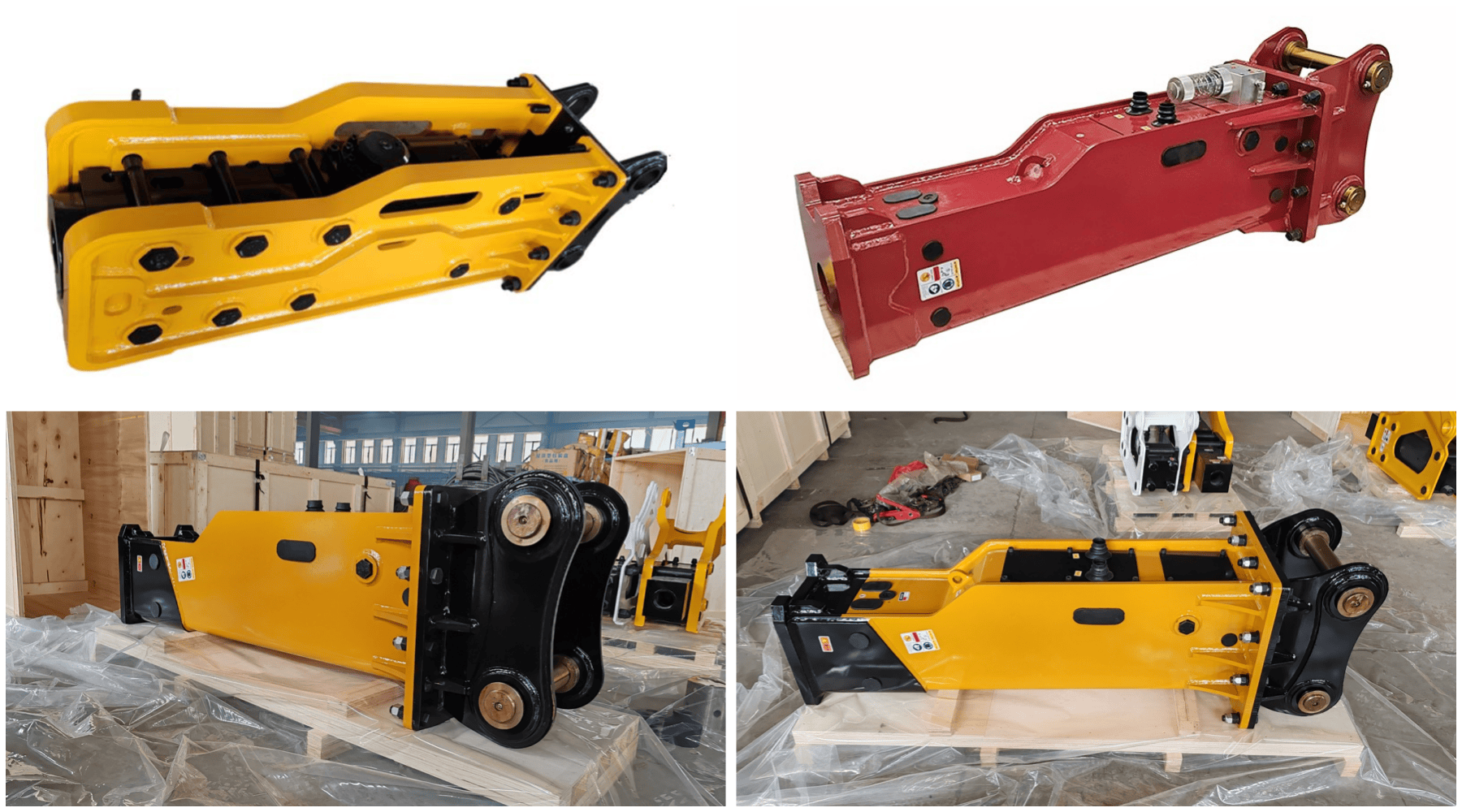
Amidst the waves of global market competition, Chinese-manufactured hydraulic breakers, relying on solid quality and strengths, have stepped into every corner of the world, becoming a shining name card for the overseas expansion of China's construction machinery.
In just a few decades, how did Chinese hydraulic breakers transform from an underdog into a trump card in the global market?
1. Industry Origins and Technical Iterations of Hydraulic Breakers
The history of mechanization for hydraulic breakers first began in Europe during the 1960s.
In 1967, Krupp of Germany successfully developed the world’s first hydraulic breaker, completely changing the traditional modes of manual rock breaking and inefficient mechanical operations, and officially initiating a brand-new era of mechanized rock breaking.
After that, European and American construction machinery giants continuously iterated and optimized product technology, establishing the early technical standards of the hydraulic breaker industry.
By the 1970s and 1980s, Japanese and South Korean enterprises keenly captured the market opportunities in construction machinery. They actively introduced mature European hydraulic breaker technology and conducted localized modifications, becoming the benchmarks of the industry at that time.
2. Core Reasons Why Chinese Hydraulic Breakers Swept the Globe
Over the past twenty years, China's mining, road maintenance, and urban renewal projects provided an excellent real-world testing ground for hydraulic breaker products, leading to a qualitative leap in quality and durability.
Relying on solid accumulation, domestic hydraulic breakers officially entered the global construction machinery track, gradually deepening their presence in emerging markets such as Southeast Asia, the Middle East, Africa, and Latin America. Today, they have successfully entered mature European and American markets, securing a firm foothold worldwide.
The core components of hydraulic breakers demand extremely high standards for special steel materials and heat treatment processes. Domestic manufacturing enterprises deeply cultivated core technologies, completely overcoming the difficulties in smelting special alloy steel while mastering mature, segmented, precision heat treatment processes.
This technological breakthrough significantly enhanced the impact resistance and fatigue resistance of the core components in domestic hydraulic breakers. Whether in extreme climates of scorching heat or freezing cold, or under harsh working conditions of high-hardness rocks and high-intensity mines, the equipment can operate continuously and stably with low failure rates and strong durability.
In contrast, most established European and American enterprises follow fixed product specifications and R&D systems. Their processes are tedious and modification cycles are long, making it difficult to adapt to the personalized construction needs of different countries and various scenarios.
From an industry novice that initially copied technology and followed passively, to an industry mainstay featuring independent R&D and leading the world, the overseas expansion path of Chinese hydraulic breakers is a true miniature of the transformation, upgrading, and rising counterattack of China's construction machinery industry.
In the future, with the continuous integration of intelligent, digital, and energy-saving technologies, domestic hydraulic breakers will achieve another upgrade in performance and experience.